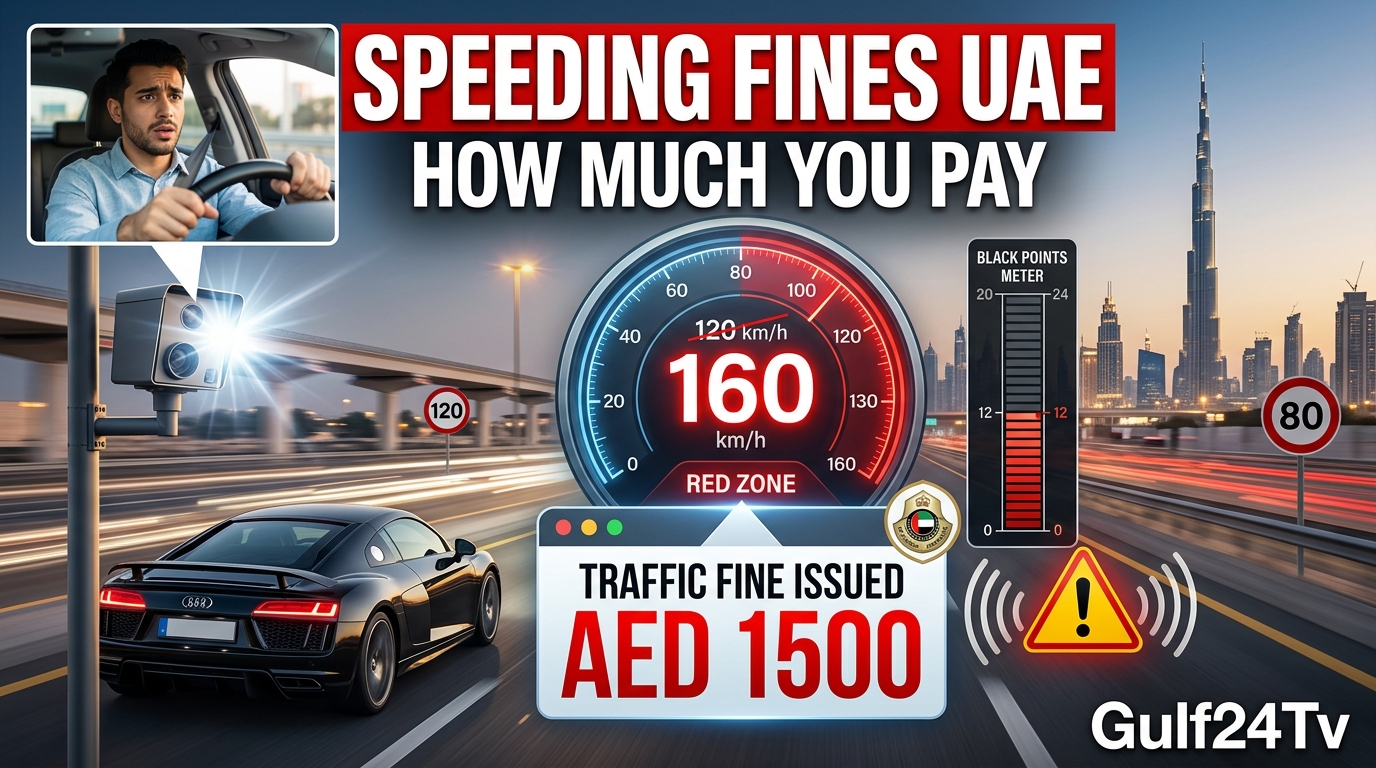
Speeding is one of the most common traffic violations in the United Arab Emirates, and if you drive here, you’ve probably seen the speed limit signs everywhere. But do you really know how much you’ll pay if you get caught speeding? The answer might surprise you, as the UAE has a very structured system for speeding fines that increases based on how much faster you’re driving than the legal limit.
If you’ve ever wondered about speeding fines in the UAE or worried that you might have received a speeding ticket, you’re not alone. Thousands of drivers face this situation every day. The good news is that platforms like Gulf24Tv make it incredibly easy to check exactly what you owe and understand your violation.
This comprehensive guide will walk you through everything you need to know about speeding fines in the UAE. You’ll learn the exact amounts you’ll pay for different speeding violations, understand the speed limits in different areas, and discover how to check your violations quickly using Gulf24Tv. By the end of this article, you’ll have a clear understanding of the UAE’s speeding fine system and how to stay safe on the roads.
Understanding the UAE Speed Limit System
Before we talk about fines, it’s important to understand the speed limits in the UAE. Different areas have different speed limits based on safety requirements and traffic conditions.
Residential areas typically have a speed limit of 40 kilometers per hour. These are areas where families live, children play, and pedestrians walk frequently. The lower speed limit is designed to protect people in these neighborhoods.
Regular city streets usually have a speed limit of 60 kilometers per hour. These are busy urban areas with shops, offices, and moderate traffic. The 60 km/h limit provides a balance between allowing traffic to flow and keeping everyone safe.
Main roads and major routes through cities often have a speed limit of 80 kilometers per hour. These roads have better conditions and fewer pedestrians, allowing for slightly faster speeds.
Highways and expressways permit speeds up to 120 kilometers per hour, and on some newer highways, the limit can reach 140 kilometers per hour. These are high-speed roads designed for long-distance travel with minimal intersections and pedestrian crossings.
Speed limit signs are clearly posted throughout the UAE. You’ll see these signs regularly as you drive, and it’s your responsibility to obey them. The signs indicate the maximum legal speed for that particular stretch of road.
How the UAE Speeding Fine System Works
The UAE has a tiered system for speeding fines, meaning the penalty increases based on how much over the speed limit you were driving. This is a smart approach because it discourages extreme speeding more severely than minor speeding.
The system is straightforward and fair. If you exceed the speed limit by a small amount, you pay a smaller fine. If you speed significantly, your fine increases accordingly. This encourages drivers to stay closer to the speed limit rather than treating it as just a suggestion.
Speed cameras throughout the UAE continuously monitor traffic and capture vehicles exceeding speed limits. These cameras are placed at locations considered particularly dangerous or prone to speeding. Some cameras are visible, while others are hidden to catch drivers who only slow down when they see enforcement.
When a speed camera detects a violation, the vehicle’s information is automatically recorded. The fine is then added to the vehicle owner’s record in the central traffic database. This is where Gulf24Tv gets its information from.
Exact Speeding Fine Amounts in the UAE
Now let’s talk about the specific amounts you’ll pay for different levels of speeding violations in the UAE. These amounts are set by the government and applied consistently across all emirates.
Speeding 1 to 20 km/h Over the Limit
If you’re driving between 1 and 20 kilometers per hour faster than the posted speed limit, your fine is 400 AED. This is the minimum speeding fine in the UAE.
This category includes minor speeding violations. Many drivers accidentally speed slightly without realizing it, perhaps pushing a bit harder on the accelerator in heavy traffic or forgetting about a speed reduction zone. While still a violation, this level of speeding is treated less severely than higher speeds.
Speeding 21 to 30 km/h Over the Limit
Exceeding the speed limit by 21 to 30 kilometers per hour results in a fine of 600 AED. This is considerably higher than the previous category, reflecting a more significant violation.
At this speed level, you’re clearly driving dangerously and not just slightly inattentive. You’re consciously ignoring the speed limit, which puts yourself and others at real risk.
Speeding 31 to 40 km/h Over the Limit
If you’re driving 31 to 40 kilometers per hour faster than the speed limit, you’ll pay 1,000 AED. This is a serious violation that demonstrates reckless behavior.
At this level of speeding, you’re driving at speeds that significantly exceed safe limits for the area. The danger increases dramatically, and the fine reflects the severity of the violation.
Speeding 41 to 50 km/h Over the Limit
Exceeding the speed limit by 41 to 50 kilometers per hour carries a fine of 1,500 AED. This is extremely dangerous driving that puts everyone’s life at risk.
Speeding at this level could turn a minor accident into a fatal one. The consequences are serious, and the fine amount reflects this gravity.
Speeding 51 to 60 km/h Over the Limit
If you’re driving 51 to 60 kilometers per hour faster than the speed limit, your fine is 2,000 AED. Additionally, your vehicle may be impounded for a period of time.
Driving at this speed is extremely reckless and dangerous. It suggests either a complete disregard for traffic laws or an emergency situation. The substantial fine and potential impoundment are serious consequences.
Speeding Over 60 km/h
Exceeding the speed limit by more than 60 kilometers per hour results in the maximum fine of 3,000 AED. In addition to this fine, your driving license will be suspended for a specified period, and your vehicle will be impounded.
This is the most serious category of speeding violation. Driving at such extreme speeds is exceptionally dangerous and illegal. The consequences are severe and designed to prevent this behavior entirely.
Speed Cameras and Where They’re Located
Speed cameras are placed strategically throughout the UAE to catch speeding drivers. These cameras are sophisticated pieces of technology that can accurately measure vehicle speeds and capture images and videos of violations.
Speed cameras are particularly common on highways and expressways where speeding is more dangerous because of the higher overall traffic speeds. They’re also placed in residential areas where safety is paramount.
Some speed cameras are permanently fixed in one location, while others are mobile and can be moved to different spots. The mobile cameras are often placed in unmarked vehicles, making them less obvious to drivers.
Cameras at certain locations are marked with warning signs that say “Speed Camera Ahead” or “Radar Enforcement.” These visible cameras are intended to slow drivers down before they reach them. However, not all camera locations are marked, so you shouldn’t assume an area is safe for speeding just because you don’t see a warning sign.
Speed cameras operate 24 hours a day, including nights and weekends. They don’t take breaks or holidays. This means you can get a speeding ticket any time, anywhere.
The technology used in these cameras is very accurate. They measure your exact speed at the moment you pass them. There’s no ambiguity or room for error. If the camera shows you were speeding, that’s conclusive evidence.
Understanding Your Speeding Violation Record
When you get a speeding fine, it’s not just about paying money. The violation goes on your driving record and affects several aspects of your driving privileges and insurance.
Every speeding violation adds points to your driving record based on the severity. Minor speeding might add 4 points, while extremely dangerous speeding can add 12 points or more.
These points accumulate over time. If you reach 24 points within a year, your driving license is suspended for three months. This means you cannot legally drive during this period. If you reach 36 points, your license can be suspended for six months.
Your insurance premiums increase when you have violation points on your record. Insurance companies see drivers with violations as higher risk, so they charge more to insure your vehicle. This additional cost can really add up over time.
Having multiple violations on your record makes it harder to convince the authorities that you’re a safe driver. This can affect your ability to renew your license or obtain certain driving endorsements.
The violations stay on your record for a full year. After a year with no additional violations, the points reset to zero. This means you get a fresh start if you drive safely.
How to Check Your Speeding Fines Using Gulf24Tv
Now that you understand the fine amounts and the system, let’s look at how to check if you have any speeding violations using Gulf24Tv. This process is quick and easy.
Accessing Gulf24Tv
First, open your web browser on any device you have access to. This could be your smartphone, tablet, or computer. Search for Gulf24Tv or type the website address directly.
Make sure you’re on the official Gulf24Tv website. The genuine website is secure and legitimate. Double-check the URL to ensure you’re on the right site.
Navigating to the Traffic Fines Section
Once you’re on the Gulf24Tv homepage, look for the traffic fines checker tool. It’s usually prominently displayed because many people use it. If you can’t find it immediately, look in the menu or use the search function on the website.
The traffic fines section is designed to be obvious and easy to find. The website developers know that people want to access this tool quickly.
Entering Your Vehicle Information
The next step requires you to enter your vehicle’s plate number. This is the unique registration number on your license plate. Look at your actual license plate and enter the number exactly as it appears.
Be very careful with this step. Even one wrong letter or number will give you incorrect results. Double-check each character before submitting.
You might also need to enter your Emirate ID number, which is your official identification number in the UAE. Make sure you have this information readily available.
Reviewing Your Results
After you submit your information, the system searches the official traffic database in just a few seconds. If you have any speeding violations, they’ll be displayed on your screen.
The results will show the date of each violation, the location where it occurred, how much over the speed limit you were driving, and the fine amount you owe.
If you have no speeding violations, the system will confirm that your vehicle has no pending speeding fines. This is obviously good news.
Understanding Your Violation Details
When you see your violation details, make sure you understand what they mean. The system shows exactly how much over the speed limit you were driving, which determines your fine amount according to the tier system explained earlier.
Pay attention to the location where the violation occurred. This can help you remember the incident or verify whether the violation makes sense.
Real-Life Examples of Speeding Fine Scenarios
Let me give you some practical examples to help you understand how the fine system works in real situations.
Example One: Residential Area Speeding
Imagine you’re driving in a residential neighborhood where the speed limit is 40 km/h. You’re driving at 55 km/h when a speed camera records you. You’ve exceeded the limit by 15 kilometers per hour, which falls in the 1 to 20 km/h category. Your fine is 400 AED.
This might seem like you were only slightly speeding, but in a residential area, even this level of speed is dangerous because children might be playing nearby.
Example Two: Highway Speeding
You’re driving on a highway where the speed limit is 120 km/h. You’re driving at 165 km/h when a camera catches you. You’ve exceeded the limit by 45 kilometers per hour, which falls in the 41 to 50 km/h category. Your fine is 1,500 AED, and your vehicle will be impounded.
This is serious speeding that puts everyone at extreme risk. The high fine and impoundment reflect the severity of this violation.
Example Three: City Street Speeding
You’re driving on a city street with a 60 km/h speed limit. You’re driving at 72 km/h when caught. You’ve exceeded the limit by 12 kilometers per hour, falling into the 1 to 20 km/h category. Your fine is 400 AED.
Even in busy city areas, maintaining the speed limit is important for safety. However, slightly exceeding it results in the minimum fine.
Common Reasons People Speed in the UAE
Understanding why people speed can help you avoid falling into the same traps.
Many drivers speed accidentally without realizing it. Perhaps they’re focused on something else or not paying attention to their speedometer. This is why dashboards typically display your speed clearly, and you should check it regularly.
Some drivers underestimate their speed because they’re used to driving fast on highways. When they enter slower-speed zones, they forget to adjust their speed accordingly.
Traffic situations sometimes lead people to speed. When someone is late for an appointment or feeling rushed, they tend to push the accelerator harder without thinking about the consequences.
Some drivers simply don’t respect speed limits, viewing them as arbitrary restrictions rather than safety measures. This attitude is both illegal and dangerous.
Tips for Avoiding Speeding Fines
The best way to avoid paying speeding fines is to never speed in the first place. Here are some practical tips to help you stay within speed limits.
Pay close attention to speed limit signs. These signs change throughout your journey, and you need to notice each change. When you see a new speed limit sign, adjust your speed immediately.
Check your speedometer frequently. Glance at it regularly to make sure you’re at or below the posted limit. Modern cars have digital speedometer displays that make this easier than ever.
Set your cruise control to the speed limit on highways. Cruise control helps you maintain a consistent speed without drifting upward gradually.
Give yourself extra time to reach your destination. When you’re not rushing, you’re less tempted to speed. Leaving early eliminates the pressure that leads to speeding.
Be aware of speed reduction zones. These are areas where the speed limit suddenly drops, like when you enter a residential area from a main road. Anticipate these changes and reduce your speed accordingly.
Remember that speed limits are not suggestions or starting points. They’re the maximum legal speed for that area, and the only safe way to drive is at or below the limit.
Understand that speeding doesn’t actually save much time on most journeys. The time saved by speeding is usually minimal, while the risks and fines are substantial.
Financial Impact of Multiple Speeding Violations
If you receive multiple speeding violations, the financial impact can become quite significant.
A single violation in the highest category costs 3,000 AED, but if you receive multiple violations over time, these costs compound quickly. Three similar violations mean 9,000 AED in fines alone.
Beyond the fine amount, your insurance premiums increase. An insurance company might charge you 20 to 50 percent more per year if you have violation points on your record. Over several years, this additional insurance cost becomes substantial.
If your license is suspended due to accumulated points, you can’t work if your job requires driving. For taxi drivers, delivery drivers, or others whose livelihood depends on driving, this is a major financial loss.
If your vehicle is impounded due to serious speeding, you must pay impoundment fees and potentially towing fees to get it back. These additional costs quickly add up.
The Impact of Speeding on Road Safety
Beyond the financial penalties, it’s important to understand why speed limits exist and how speeding affects road safety.
Speed affects stopping distance dramatically. The faster you’re traveling, the longer it takes to stop. At 60 km/h, you need about 30 meters to stop after seeing a hazard. At 90 km/h, you need about 67 meters. This difference can be the difference between avoiding an accident and having one.
Speeding reduces your ability to control your vehicle. The faster you go, the less control you have when you need to swerve or adjust direction quickly.
Speeding makes accidents more severe. A crash at high speed causes much more damage than the same crash at low speed. The difference between a minor injury accident and a fatal accident is often just a few kilometers per hour.
Speeding endangers not just you but everyone on the road. Pedestrians, other drivers, and passengers in your vehicle all face greater risk when you speed.
Frequently Asked Questions About Speeding Fines
Can I dispute a speeding fine if I believe it was given in error?
Yes, you can appeal a speeding fine. Visit your local traffic police office with supporting evidence. The process can take several weeks, but it’s worth pursuing if you truly believe the violation was incorrect. Provide any evidence you have, such as vehicle maintenance records or witness statements.
What’s the difference between the speed shown on my speedometer and the camera speed?
Your speedometer typically shows a slightly higher speed than your actual speed. This is why cameras calibrated to the actual speed might catch you even if your speedometer shows you’re at the limit. The cameras use more accurate measuring methods than your speedometer.
How long does it take for a speeding violation to appear in the system?
Usually, speeding violations appear in the system within 48 hours to two weeks after the camera records them. If you think you got a speeding ticket and don’t see it yet, check again in a few days.
Are all speed cameras marked with warning signs?
No, not all speed cameras have warning signs. While many visible cameras have signs warning drivers, hidden cameras don’t. You shouldn’t assume an area is safe for speeding just because you don’t see a warning sign.
What should I do if I receive a speeding fine I don’t remember?
First, check the details carefully. The violation includes the date, time, and location. Even if you don’t remember the specific incident, the camera evidence is conclusive. Pay the fine if you cannot successfully appeal it.
Can I pay my speeding fine in installments?
Most speeding fines must be paid in full. However, if you face genuine financial hardship, contact the traffic police office to discuss your situation. In rare cases, they might work out a payment arrangement.
How do traffic violations affect my ability to renew my vehicle registration?
You cannot renew your vehicle registration if you have outstanding traffic fines, including speeding fines. You must pay all fines before renewal is possible. This is why it’s important to pay promptly.
Do speeding violations affect my ability to rent a car?
Most car rental companies in the UAE check a driver’s record before renting. If you have too many violations or unpaid fines, they might refuse to rent you a vehicle. Some companies charge higher rental rates for drivers with violation records.
What’s the maximum fine for speeding in the UAE?
The maximum speeding fine is 3,000 AED, given for speeding more than 60 km/h over the limit. This is the same as fines for other serious traffic violations.
Will my speeding violation affect my job if I have a commercial driving license?
Yes, it can. Professional drivers are held to higher standards, and violations on their records can affect their employment. Some companies won’t hire drivers with violation points, and others might terminate employment based on accumulated violations.
Understanding Speed Limits in Different Emirates
While the speeding fine system is consistent across the UAE, speed limits might vary slightly between emirates and specific roads. Here’s what you should know.
In Dubai, speed limits are clearly marked and consistently enforced. The city has extensive speed camera networks, particularly on major roads and highways.
Abu Dhabi also has strict speed limit enforcement. The emirate has been focusing on road safety, and cameras are placed strategically throughout the city and surrounding areas.
Sharjah, Ajman, and the other emirates have similar speed limit systems. Speed limits are marked with clear signs, and violations are recorded in the same national database.
On newly constructed roads, speeds might be different from older roads in the same area. Always pay attention to signs indicating current speed limits rather than relying on what you remember from previous visits.
What Happens If You Don’t Pay Your Speeding Fine
Not paying a speeding fine creates serious problems that go far beyond just owing money.
Your vehicle registration cannot be renewed. When your current registration expires and you have outstanding fines, you cannot legally drive your vehicle. This means you cannot use your car at all.
Late fees accumulate. The longer you wait, the more you owe beyond the original fine. Sometimes late fees can double the original fine amount.
Your driving license can be suspended. If you accumulate enough violation points from unpaid fines, your license will be suspended for a period.
You can face legal action. The authorities can take you to court over unpaid fines, which leads to additional legal consequences.
In extreme cases, your departure from the UAE can be blocked. If you have substantial unpaid fines, you might not be allowed to leave the country until they’re settled.
Your vehicle can be impounded if you have serious unpaid violations. Recovery of the vehicle then requires paying the fine plus additional impoundment fees.
How to Stay Safe and Avoid Speeding
Ultimately, the best approach is to drive safely and never speed in the first place. Here are some final tips to help you maintain safe driving habits.
Respect speed limits as safety measures, not obstacles. They exist because people have died at higher speeds on those roads. Treating them seriously protects your life and others.
Develop the habit of checking your speedometer every few seconds. Make it as automatic as checking your mirrors.
Plan your trips with enough time to reach your destination without rushing. Time pressure is a major factor in speeding violations.
Stay focused on the road. Distractions like mobile phones or passengers can cause you to unconsciously speed up.
Maintain your vehicle properly. Faulty brakes or tires can affect your ability to control speed.
Conclusion
Speeding fines in the UAE are serious penalties with amounts that can reach 3,000 AED for the most severe violations. The tiered system is designed to discourage speeding based on severity, and the consequences extend beyond money to include suspension, impoundment, and legal action.
Using Gulf24Tv makes it easy to check any speeding violations you might have. The process takes just a few minutes and gives you accurate information directly from official traffic databases.
The most important takeaway is that avoiding speeding is far better than dealing with fines. By respecting speed limits, you protect yourself, your passengers, pedestrians, and other drivers. You also avoid the substantial financial penalties and other consequences that come with speeding violations.
Start checking your traffic record regularly on Gulf24Tv to stay informed about your driving status. If you have any speeding fines, pay them promptly to avoid late fees and other complications.
Drive safely, respect speed limits, and remember that no destination is worth the risk of speeding. Your life and the lives of others on the road are far more valuable than saving a few minutes on your journey.
For more information about traffic regulations, vehicle management, and safe driving practices in the UAE, visit PakLife.net. This platform provides comprehensive resources for drivers across the Gulf region who want to stay informed and safe on the roads.