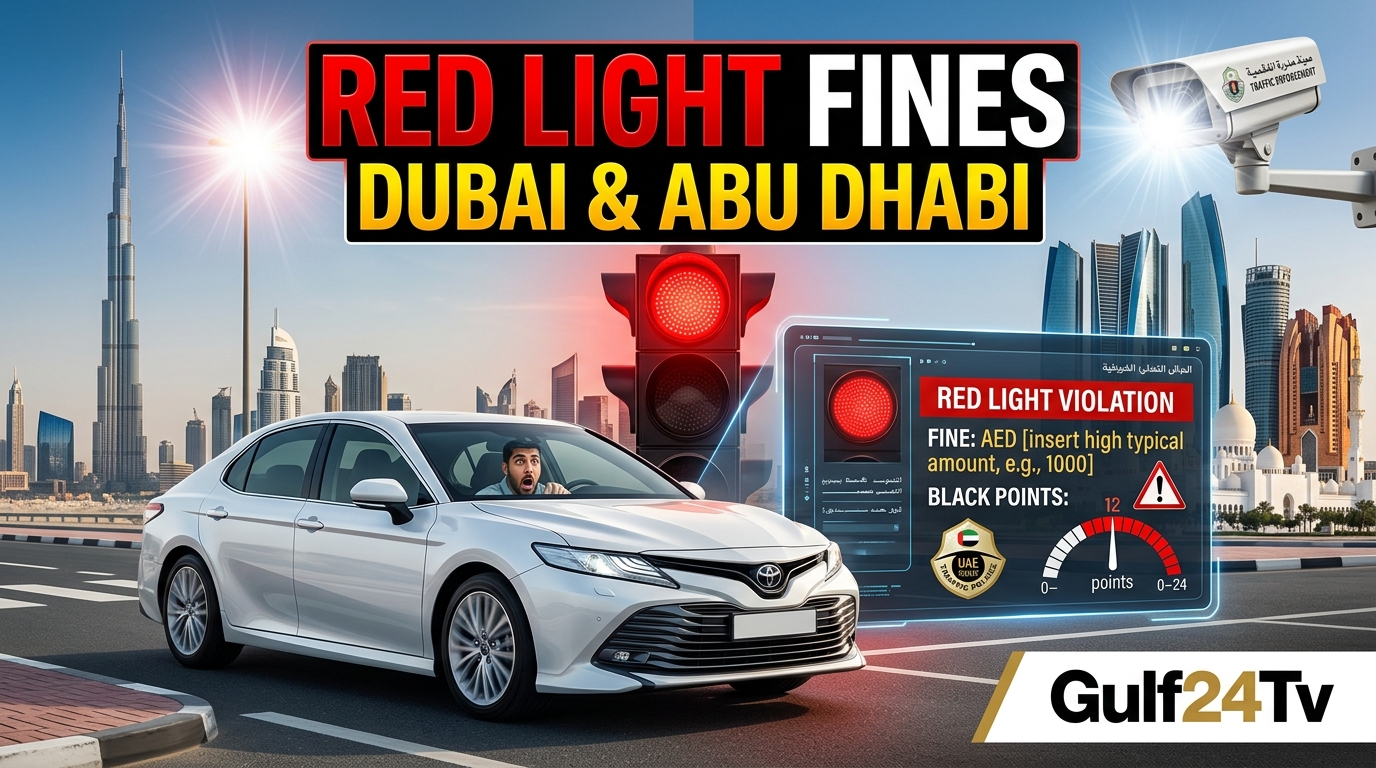
Running a red light is one of the most dangerous and heavily penalized traffic violations in the United Arab Emirates. Every day, thousands of vehicles pass through hundreds of intersections across Dubai and Abu Dhabi, and traffic signals keep this complex system flowing safely and efficiently. When drivers ignore these signals, they put themselves and countless others at serious risk.
The consequences of running a red light extend far beyond the immediate fine. This violation can lead to devastating accidents, serious injuries, and even loss of life. Understanding the penalties, the technology that enforces these rules, and most importantly, how to avoid committing this violation helps you become a safer, more responsible driver.
Whether you are a new driver, a long-time resident, or a visitor to the UAE, this comprehensive guide will explain everything you need to know about red light violations in Dubai and Abu Dhabi. Gulf24Tv consistently provides updates about traffic safety and regulations, and this guide brings together essential information to help you navigate intersections safely and legally.
Understanding Red Light Violations
A red light violation occurs when a vehicle crosses the stop line or enters an intersection after the traffic signal has turned red. The moment the light changes from yellow to red, all vehicles must be completely stopped before the stop line. Any vehicle that continues moving and crosses this line after the light turns red commits a violation.
Many drivers misunderstand what constitutes a red light violation. Some believe that entering the intersection during the yellow light provides protection, but this is not entirely accurate. The yellow light serves as a warning that the signal is about to turn red, giving you time to safely stop before reaching the intersection.
If you are already in the intersection when the light turns red, you should complete your passage through safely. However, if you are approaching the intersection and the light turns yellow, you should stop unless stopping would be dangerous due to your speed and distance from the intersection.
Red light cameras capture violations with precision. These sophisticated systems photograph and record video of vehicles that enter intersections after signals turn red. The cameras capture multiple images showing the vehicle’s position before and after the light change, providing clear evidence of the violation.
The technology behind red light enforcement has become incredibly advanced. Sensors embedded in the road detect when vehicles cross the stop line, triggering cameras only when violations actually occur. This precision ensures that drivers receive fines only for genuine violations, not for stopping slightly past the line or being caught in the intersection when the light changes.
Understanding exactly what constitutes a violation helps you avoid this serious offense and the severe penalties that accompany it.
Red Light Fines and Penalties in Dubai
Dubai takes red light violations extremely seriously, imposing significant penalties designed to deter this dangerous behavior and promote intersection safety.
The fine for running a red light in Dubai is 1,000 AED. This substantial amount reflects the serious nature of the violation and the potential consequences it could cause. In addition to the monetary fine, you receive 12 black points added to your driving license, which is one of the highest black point penalties for traffic violations.
Beyond the fine and black points, your vehicle will be confiscated for 30 days. This means you cannot use your car for an entire month, creating significant inconvenience and potentially affecting your work and daily life. The confiscation period begins from the date authorities impound your vehicle, not from when the violation occurred.
To release your vehicle after the 30-day confiscation period, you must pay the fine plus daily storage fees that accumulate while your vehicle is impounded. These storage fees typically range from 25 AED to 50 AED per day, adding substantial cost to the original fine. For a 30-day confiscation, storage fees alone can reach 750 AED to 1,500 AED.
The total cost of a red light violation in Dubai often exceeds 2,000 AED when you combine the fine, storage fees, and other associated costs. This does not even account for the inconvenience of being without your vehicle for a month or the transportation expenses you incur during that period.
The 12 black points that accompany this violation represent half of the 24 points that trigger automatic license suspension. If you commit just two red light violations within a year, you will reach the 24-point threshold and face license suspension for three months on the first offense.
Dubai’s strict penalties reflect the emirate’s commitment to road safety. Statistics consistently show that intersection accidents, many caused by red light violations, result in serious injuries and fatalities. The heavy penalties aim to make drivers think twice before risking everyone’s safety by ignoring traffic signals.
Gulf24Tv regularly reports on traffic safety campaigns in Dubai, including special enforcement periods when authorities increase monitoring of red light violations and other dangerous behaviors at intersections.
Red Light Fines and Penalties in Abu Dhabi
Abu Dhabi imposes penalties identical to Dubai for red light violations, demonstrating the UAE’s unified approach to this serious offense across different emirates.
The fine for running a red light in Abu Dhabi is 1,000 AED, the same as in Dubai. You also receive 12 black points on your driving license and face vehicle confiscation for 30 days. This consistency across emirates ensures that drivers cannot exploit different penalty structures by committing violations in areas with lighter consequences.
The vehicle confiscation process in Abu Dhabi follows similar procedures to Dubai. Authorities impound your vehicle for 30 days, during which you must arrange alternative transportation. After the confiscation period ends, you must pay all fines and accumulated storage fees before retrieving your vehicle.
Storage fees in Abu Dhabi typically range from 25 AED to 50 AED per day, depending on the vehicle type and the specific impound facility. These fees accumulate throughout the entire confiscation period, significantly increasing the total cost of the violation.
Abu Dhabi’s traffic enforcement system uses advanced red light cameras at major intersections throughout the emirate. The capital has invested heavily in traffic safety technology, ensuring comprehensive coverage of high-traffic areas where violations pose the greatest danger.
The combination of the 1,000 AED fine, 12 black points, and 30-day vehicle confiscation makes red light violations one of the most severely penalized traffic offenses in Abu Dhabi. This severe treatment reflects the serious safety risks these violations create at intersections throughout the capital.
Both Abu Dhabi and Dubai coordinate their traffic safety efforts, sharing best practices and technology to create consistent enforcement across the most populated areas of the UAE. This coordination ensures that drivers experience the same high standards of traffic law enforcement regardless of which emirate they drive in.
How Red Light Camera Systems Work
Understanding how red light camera systems work helps you appreciate the sophistication of traffic enforcement in the UAE and clarifies exactly what triggers violations.
Red light cameras are installed at intersections throughout Dubai, Abu Dhabi, and other emirates. These cameras are typically mounted on poles near traffic signals, positioned to capture clear images of vehicles approaching and entering intersections.
The camera systems work in conjunction with sensors embedded in the road surface. These sensors detect when vehicles cross the stop line that marks where drivers must stop when signals are red. The sensors communicate with the camera system, triggering it only when a vehicle crosses the line after the signal has turned red.
When a violation occurs, the camera system captures multiple images in rapid succession. The first image shows the traffic signal displaying red and the vehicle approaching or at the stop line. Subsequent images show the vehicle crossing the line and entering the intersection while the signal remains red. This sequence provides undeniable evidence of the violation.
Modern red light cameras also record video footage, not just still images. This video documentation shows the entire violation from start to finish, including the traffic signal status and the vehicle’s movement through the intersection. Video evidence eliminates any ambiguity about whether a violation occurred.
The cameras capture clear images of license plates, allowing authorities to identify the vehicle and its registered owner. The image quality remains high even in challenging conditions like nighttime, rain, or bright sunlight, ensuring violations are properly documented regardless of when they occur.
After capturing a violation, the system automatically processes the images, identifies the vehicle through license plate recognition technology, and generates a fine that is added to the registered owner’s record. This entire process happens automatically without requiring officers to manually review every violation.
The registered vehicle owner receives notification of the violation through the official police apps, SMS if registered for alerts, or when checking their fine record through official channels. The notification includes details about when and where the violation occurred, often with access to the photographic or video evidence.
Red light cameras operate 24 hours a day, seven days a week, ensuring constant enforcement at monitored intersections. This continuous operation means you can receive a fine for violations committed at any time, day or night.
The UAE’s investment in this technology has significantly improved intersection safety. Studies show that intersections with red light cameras experience fewer serious accidents compared to those without automated enforcement. The cameras serve as both enforcement tools and deterrents, encouraging drivers to obey traffic signals even when police officers are not visibly present.
Common Situations Leading to Red Light Violations
Understanding the common situations that lead to red light violations helps you recognize and avoid these dangerous scenarios in your own driving.
Misjudging yellow light timing is one of the most frequent causes of red light violations. Drivers approaching intersections sometimes believe they have enough time to clear the intersection before the light turns red, but they misjudge the distance or the timing. The light changes to red while they are still approaching or entering, resulting in a violation.
The yellow light duration is carefully calculated based on the speed limit and intersection size. If you see a yellow light and are not already very close to the intersection, the safe choice is always to stop. Trying to beat the light creates risk and frequently results in violations.
Distracted driving contributes significantly to red light violations. Drivers looking at their phones, adjusting navigation systems, talking to passengers, or simply not paying attention fail to notice the signal changing. By the time they look up, they have already entered the intersection against a red signal.
Following too closely behind other vehicles through intersections causes violations when the lead vehicle clears the intersection just as the light turns red but following vehicles do not. Each vehicle must ensure the signal allows their passage, not simply follow the car ahead blindly.
Speeding approaching intersections reduces your ability to stop safely when signals change. Higher speeds require longer stopping distances, meaning you might not be able to stop in time when a light turns yellow. This situation forces a choice between harsh braking or continuing through, often resulting in violations.
Unfamiliarity with intersection layouts confuses some drivers, especially in complex intersections with multiple lanes and signals. Drivers might watch the wrong signal or misunderstand which signal controls their lane, leading to violations when they proceed on a signal that does not apply to them.
Attempting to turn right on red at intersections where this is prohibited causes violations. While many intersections in the UAE allow right turns on red after stopping and ensuring the way is clear, some intersections prohibit this due to pedestrian traffic or sight line restrictions. Clear signs indicate where right on red is not allowed, but drivers sometimes miss or ignore these signs.
Impatience and aggressive driving lead some drivers to intentionally run red lights to avoid waiting through signal cycles. This deliberate risk-taking is inexcusable and creates serious danger for crossing traffic and pedestrians.
How to Check Red Light Violation Fines
If you suspect you might have committed a red light violation or want to verify your driving record, several methods allow you to check for fines quickly and easily.
The Dubai Police app provides the most convenient method for checking violations in Dubai. Download the free app from the App Store or Google Play, register using your Emirates ID or traffic file number, and log in to view all your traffic fines. Red light violations appear with complete details including the violation date, time, location, fine amount, black points, and often links to photographic or video evidence.
The Abu Dhabi Police app serves the same function for violations in the capital. The interface is user-friendly and available in both Arabic and English, making it accessible to all drivers regardless of their primary language.
Official police websites for both emirates offer the same fine checking services through computer browsers. Visit the Dubai Police or Abu Dhabi Police website, navigate to the traffic services section, and enter your vehicle information to view all outstanding fines.
SMS services provide quick checks even without internet access. Send a text message with your vehicle plate information to the designated short code for your emirate, and you receive a reply listing your fines.
When you find a red light violation on your record, you can usually view the evidence that triggered the fine. The apps and websites often provide access to the photographs or video footage showing your vehicle entering the intersection against the red signal. Reviewing this evidence helps you understand exactly what happened and verify the accuracy of the violation.
If you believe a red light violation was issued in error, viewing the evidence is the first step in determining whether to contest the fine. However, the camera systems are highly accurate, and genuine errors are extremely rare.
Regular checking of your fine record, perhaps monthly or after driving through unfamiliar areas, helps you stay aware of any violations and address them promptly. Some fines offer early payment discounts, so discovering violations quickly can save you money.
Gulf24Tv recommends that all drivers regularly check their traffic fine records to avoid surprises during vehicle registration renewal or when attempting other services that require clean records.
Paying Red Light Violation Fines
Once you have confirmed a red light violation on your record, paying the fine promptly is essential to begin the vehicle confiscation period and eventually recover your car.
You can pay red light fines through all the standard traffic fine payment methods available in the UAE. The Dubai Police and Abu Dhabi Police apps allow direct payment using credit or debit cards. Simply select the fine in the app and follow the payment prompts to complete the transaction securely.
Official police websites offer the same online payment functionality. Navigate to your fines, select the red light violation, and proceed to payment using your bank card.
Banking apps and ATMs that offer traffic fine payment services also accept payments for red light violations. Log into your mobile banking app or use an ATM with traffic services, enter your vehicle information, select the fine, and complete the payment.
Physical payment centers operated by police departments accept cash and card payments for red light violations. Visit any service center with your Emirates ID and vehicle information to pay your fine in person.
After paying the fine, you must still wait for the 30-day vehicle confiscation period to complete before you can retrieve your vehicle. The confiscation period does not reduce just because you paid the fine quickly. It is a separate penalty component that must be served in full.
Keep your payment receipt as proof that the fine has been settled. You will need this documentation when retrieving your vehicle after the confiscation period ends.
During the confiscation period, storage fees accumulate daily. These fees must be paid along with proof of fine payment before authorities will release your vehicle. The total cost including storage can be substantial, often doubling the initial 1,000 AED fine.
Vehicle Confiscation and Release Process for Red Light Violations
The vehicle confiscation process for red light violations follows specific procedures that you must understand to navigate the situation effectively.
When authorities issue a red light violation, your vehicle is typically impounded shortly after the violation is confirmed. In some cases, officers may stop you and impound the vehicle immediately if they witness the violation. In other cases, you receive notification that your vehicle should be presented for confiscation.
Failing to present your vehicle for confiscation when required can result in additional penalties and complications. It is always better to comply with confiscation requirements promptly rather than attempting to avoid or delay the process.
Your vehicle remains at an official impound facility for exactly 30 days from the confiscation date. During this period, you cannot use your vehicle and must arrange alternative transportation. This creates significant inconvenience, especially if you depend on your car for work or family responsibilities.
After the 30-day confiscation period expires, you can begin the release process. First, ensure you have paid the 1,000 AED fine. If you have not paid it yet, you must do so before proceeding.
Gather the required documents including your Emirates ID, valid driving license, vehicle registration certificate, and proof of fine payment. If someone else will collect the vehicle on your behalf, they need a notarized authorization letter along with their own identification documents.
Visit the impound facility during working hours with all required documents. The authorities will calculate the storage fees based on the number of days your vehicle was impounded and the daily storage rate. Pay these fees along with presenting your fine payment proof.
The authorities inspect your vehicle to verify its condition and ensure it meets safety and legal requirements. They check that the vehicle matches the registration documents and has not been modified or damaged during storage.
Once all requirements are satisfied and fees are paid, you receive clearance to collect your vehicle. The facility provides you with the necessary paperwork to exit with your car.
The entire release process can take several hours, so plan accordingly and ensure you have sufficient time when visiting the impound facility.
Some drivers explore whether they can reduce the confiscation period or avoid it entirely. Unfortunately, the 30-day vehicle confiscation for red light violations is mandatory and cannot be reduced or waived. It serves as a serious deterrent designed to make drivers fully appreciate the consequences of this dangerous violation.
Contesting Red Light Violations
While red light camera systems are highly accurate and violations are usually legitimate, you have the right to contest fines you believe were issued in error.
Valid reasons for contesting a red light violation might include emergency situations where you had to proceed through a red light to avoid a more serious accident, vehicle malfunctions like brake failure that prevented stopping, or technical errors where the camera or sensors malfunctioned.
However, these situations are rare, and the burden of proof lies with you to demonstrate that the violation was not your fault or did not actually occur as recorded.
To contest a red light violation, access the evidence through the police app or website. Review the photographs or video footage carefully to understand exactly what the camera captured. If the evidence clearly shows your vehicle entering the intersection against a red signal, contesting the fine is unlikely to succeed.
If you believe you have legitimate grounds for an objection, file your contest through the official police app, website, or by visiting a service center in person. Provide detailed explanation of why the violation should be cancelled and submit any supporting evidence such as photographs, dashcam footage, witness statements, or documentation of vehicle malfunctions.
Traffic authorities review objections carefully and make decisions based on the evidence presented. The review process typically takes several days to a few weeks depending on case complexity and the volume of objections being processed.
If your objection is approved, the fine, black points, and vehicle confiscation are cancelled, and you receive notification of the decision. If the objection is rejected, you must pay the fine and complete the confiscation period as originally required.
Frivolous objections that clearly contradict photographic or video evidence are quickly rejected. Filing unfounded objections delays the process and might cause you to miss early payment discount opportunities if they exist.
Most drivers who review the violation evidence realize the fine is legitimate and choose to accept the penalty rather than contest it. The camera systems rarely make mistakes, and attempting to dispute clear violations wastes time and resources.
Impact of Red Light Violations on Driving Record
Red light violations create significant negative impacts on your driving record that extend beyond the immediate fine and vehicle confiscation.
The 12 black points that accompany red light violations represent a substantial portion of the 24 points that trigger license suspension. Just two red light violations within a year result in automatic license suspension for three months minimum.
Even if you do not reach the suspension threshold, the accumulated black points on your record can affect various aspects of your driving privileges and related services.
Insurance companies consider your driving record when calculating premiums and determining coverage eligibility. Multiple violations or serious offenses like running red lights can result in significantly higher insurance costs. Some insurers might decline coverage altogether for drivers with very poor records.
Employment in driving-related professions becomes difficult or impossible with a record showing serious violations. Companies hiring professional drivers, delivery personnel, or company vehicle operators prefer candidates with clean driving records. Red light violations signal poor judgment and disregard for safety, making you a less attractive candidate.
The black points remain on your record for one year from the violation date. During this period, any additional violations add to your total, potentially triggering license suspension. You must drive extremely carefully after a red light violation to avoid accumulating more points.
After one year without additional violations, the black points automatically disappear from your record. This clean slate provides an opportunity to start fresh, but the violation might still appear in your complete driving history even after the black points are removed.
For more information about how traffic violations affect various aspects of life in the UAE, visit https://paklife.net/ where comprehensive guides cover everything from driving regulations to residency and employment considerations.
Statistics and Safety Impact of Red Light Violations
Understanding the statistics and safety impact of red light violations helps illustrate why UAE authorities treat this offense so seriously.
Traffic studies consistently show that intersection accidents account for a significant percentage of all traffic collisions. Many of these accidents occur when drivers run red lights, creating dangerous situations for crossing traffic that has the legal right of way.
The physics of intersection collisions make them particularly dangerous. When vehicles collide at intersections, they often strike each other at high speeds from perpendicular angles, creating tremendous forces that vehicle safety features struggle to protect against. Side-impact collisions are especially dangerous because vehicles offer less protection on the sides compared to the front and rear.
Red light violations create situations where drivers expecting to safely cross an intersection suddenly face vehicles entering illegally from another direction. The surprise element reduces reaction time, making accidents more likely and more severe.
Pedestrians crossing at intersections face extreme danger when drivers run red lights. Pedestrian signals coordinate with vehicle signals to ensure safe crossing times. When vehicles ignore red lights, pedestrians lawfully in crosswalks face potentially fatal collisions.
Statistics from Dubai and Abu Dhabi show that strict enforcement of red light violations through camera systems has reduced intersection accidents over time. Intersections with red light cameras typically experience fewer serious collisions compared to similar intersections without cameras.
The deterrent effect of heavy penalties discourages red light violations. When drivers know that running a red light costs 1,000 AED, 12 black points, and 30 days of vehicle confiscation, they think twice before taking the risk. This behavioral change saves lives and prevents injuries.
Educational campaigns combined with strict enforcement create the most effective reduction in violations. Gulf24Tv regularly features traffic safety messages that remind drivers about the dangers of running red lights and the severe consequences, contributing to increased awareness throughout the community.
Tips to Avoid Red Light Violations
Prevention is always better than dealing with violations and penalties. These practical tips help you avoid running red lights and stay safe at intersections.
Approach all intersections with heightened awareness. Reduce your speed slightly and increase your attention to traffic signals and surrounding conditions. This defensive approach gives you more time to react to signal changes.
Understand yellow light timing and always err on the side of caution. If you see a yellow light and you are not already very close to the intersection, stop. The few seconds you save by trying to beat the light are never worth the risk of causing an accident or receiving a severe penalty.
Avoid speeding especially when approaching intersections. Higher speeds reduce your ability to stop safely when signals change and increase the likelihood that you will enter an intersection just as the light turns red.
Maintain proper following distance from vehicles ahead. Do not assume that if the car in front of you makes it through the intersection, you can follow. Each vehicle must independently ensure the signal allows safe passage.
Eliminate distractions while driving through intersections. Put your phone away, pause conversations, and focus completely on the traffic signals and surrounding conditions. Distracted driving at intersections causes countless violations and accidents.
Familiarize yourself with intersection layouts in areas you drive frequently. Understand which signals control which lanes, where stop lines are located, and any special rules like no right turn on red restrictions.
Use navigation apps that alert you to upcoming red light cameras. While you should always obey traffic signals regardless of camera presence, these alerts serve as reminders to pay extra attention at monitored intersections.
Plan your routes to avoid rushing. Leaving adequate time for your journey reduces the temptation to take risks like running red lights to save a few minutes. The time you might save is never worth the potential consequences.
If you accidentally enter an intersection just as the light turns red, proceed through carefully rather than stopping in the middle of the intersection. Stopping in the intersection creates more danger than completing your passage safely. However, be aware that you may still receive a fine if cameras captured the violation.
Watch for signal timing patterns at lights you encounter regularly. Understanding how long cycles typically last helps you anticipate changes and make better decisions about whether to proceed or stop as you approach.
Red Light Violations During Emergency Situations
Sometimes drivers face difficult situations where proceeding through a red light seems necessary due to emergency circumstances. Understanding how authorities view these situations helps you make informed decisions.
Genuine emergencies such as rushing someone to the hospital, avoiding an imminent collision, or complying with police or emergency vehicle instructions might justify proceeding through a red light. However, you must still exercise extreme caution to avoid causing accidents while addressing the emergency.
If you run a red light during a legitimate emergency, you will likely still receive a fine initially since the camera system cannot distinguish emergencies from regular violations. However, you can file an objection explaining the emergency circumstances and providing supporting evidence.
Medical emergencies should ideally be handled by calling ambulance services rather than driving yourself. Emergency medical professionals can provide care during transport and navigate traffic safely with sirens and lights. However, if you genuinely have no choice but to drive someone to the hospital yourself, document the situation as thoroughly as possible including hospital admission records that verify the emergency timing.
Emergency vehicle interactions sometimes require proceeding through red lights, such as when police officers directing traffic instruct you to proceed despite signal status. If cameras capture these situations, explain the circumstances when contesting the fine and identify the officers who gave instructions if possible.
Mechanical failures like brake malfunctions might prevent you from stopping at a red light safely. If this occurs, proceed through the intersection while warning other drivers with your horn and hazard lights, then immediately pull over safely and address the mechanical issue. Vehicle maintenance records and mechanic reports can support objections based on mechanical failure.
While these emergency exceptions exist in theory, proving them sufficiently to have fines cancelled is challenging. The best approach is always preventing situations where you must choose between obeying traffic signals and addressing emergencies.
Technology Advancements in Red Light Enforcement
The UAE continues investing in advanced technology to improve red light enforcement and overall intersection safety.
Artificial intelligence systems now analyze traffic patterns at intersections, predicting when violations are likely to occur based on traffic density, time of day, and historical data. This predictive capability helps authorities optimize camera placement and enforcement resources.
Integration of red light cameras with other traffic management systems creates comprehensive intersection monitoring. These integrated systems track traffic flow, adjust signal timing dynamically, and coordinate emergency vehicle passage while maintaining enforcement of traffic laws.
Smart intersection technology being implemented in Dubai and Abu Dhabi includes sensors that detect pedestrians and cyclists, adjusting signal timing to ensure adequate crossing time. These systems reduce conflicts between vehicles and vulnerable road users, improving overall safety.
Mobile enforcement units supplement fixed red light cameras, allowing authorities to monitor intersections temporarily based on complaint patterns or known violation trends. This flexibility ensures enforcement extends beyond permanently monitored locations.
Advanced data analytics examine violation patterns, identifying intersections with unusually high violation rates that might indicate signal timing problems, visibility issues, or design flaws requiring correction. This data-driven approach continuously improves intersection safety.
Public awareness systems display real-time violation data and safety messages at intersections, reminding drivers of the penalties and encouraging compliance. These educational components complement enforcement efforts.
Gulf24Tv regularly features stories about new traffic technology implementations, keeping the public informed about innovations that affect daily driving experiences throughout Dubai and Abu Dhabi.
Frequently Asked Questions
What exactly is the fine for running a red light in Dubai and Abu Dhabi?
The fine for running a red light in both Dubai and Abu Dhabi is 1,000 AED. Additionally, you receive 12 black points on your driving license and your vehicle is confiscated for 30 days. Total costs including storage fees during confiscation often exceed 2,000 AED.
Can the vehicle confiscation period be reduced or waived?
No, the 30-day vehicle confiscation period for red light violations is mandatory and cannot be reduced or waived. This penalty must be served in full regardless of circumstances or early fine payment.
What happens if I run a red light while driving a rental car?
The fine initially appears on the rental company’s record. The company will contact you and charge the fine, storage fees, and an administrative fee to your credit card. You remain responsible for all penalties even though you do not own the vehicle.
How long do black points from a red light violation stay on my record?
Black points remain on your driving record for one year from the violation date. After one year without additional violations, the points automatically disappear. However, the violation may still appear in your complete driving history.
Can I contest a red light violation if I believe it was issued in error?
Yes, you can file an objection through official police apps, websites, or service centers. You must provide evidence supporting your claim that the violation did not occur or was unavoidable. Authorities review objections and cancel fines if evidence supports your case.
Do red light cameras work at night and in bad weather?
Yes, red light cameras operate 24 hours a day in all weather conditions. The cameras use advanced technology that captures clear images regardless of lighting or weather, ensuring violations are properly documented whenever they occur.
What should I do if the light turns red while I am already in the intersection?
If you are already in the intersection when the light turns red, proceed through safely. You should not receive a violation for completing passage through an intersection you lawfully entered. However, if you enter after the light turns red, you have committed a violation.
How can I view the photographic evidence of my red light violation?
Access the evidence through official police apps or websites where you check your fines. Most violations include links to photographs or video footage showing your vehicle entering the intersection against the red signal.
Will my car insurance rates increase after a red light violation?
Possibly. Insurance companies consider your driving record when calculating premiums. Serious violations like running red lights can result in higher insurance costs when renewing your policy, as they indicate higher risk.
What happens if I cannot pay the fine and storage fees to release my vehicle?
If you cannot pay the required fees, your vehicle remains impounded and storage fees continue accumulating daily. Some drivers facing financial hardship can request payment plans by visiting police service centers and explaining their situation, though approval is not guaranteed.
Conclusion
Red light violations represent one of the most serious and dangerous traffic offenses in Dubai and Abu Dhabi. The severe penalties including 1,000 AED fines, 12 black points, and 30-day vehicle confiscation reflect the grave safety risks these violations create at intersections throughout the UAE.
Understanding the consequences, the technology that enforces these rules, and most importantly the strategies to avoid violations helps you become a safer driver who protects yourself and everyone sharing the road. Every traffic signal serves a critical safety function, ensuring orderly traffic flow and protecting pedestrians, cyclists, and motorists alike.
The few seconds you might save by running a red light are never worth the potential consequences. Beyond the financial penalties and inconvenience of vehicle confiscation, you risk causing devastating accidents that could injure or kill innocent people. No destination is important enough to justify taking such risks.
Make it your personal commitment to always respect traffic signals. Approach intersections with caution, stop for yellow lights unless already committed to the intersection, and never deliberately run red lights regardless of time pressures or impatience.
Gulf24Tv remains dedicated to promoting traffic safety awareness throughout Dubai, Abu Dhabi, and the entire UAE. Following trusted information sources helps you stay informed about traffic regulations, safety campaigns, and enforcement initiatives designed to protect everyone on the roads.
For comprehensive guides covering all aspects of living, working, and driving safely in the UAE, visit https://paklife.net/ where you will find valuable resources about traffic regulations, residency procedures, and practical daily living advice.
Remember that traffic lights exist to protect you and your community. Respecting these signals demonstrates your commitment to safety, responsibility, and the wellbeing of everyone who uses UAE roads. Drive with awareness, patience, and respect for traffic laws, and you will never need to worry about red light violations or their severe consequences.
Your driving choices matter. Make the right choice every time you approach an intersection, and contribute to the UAE’s vision of having the safest, most efficiently managed roads in the world. Safe driving is not just about avoiding fines; it is about preserving lives and creating communities where everyone can travel with confidence and security.